Quick answer
Yes, Canadian citizens and permanent residents can move freely to any province under Section 6 of the Charter of Rights and Freedoms. If you hold an open work permit (PGWP/SOWP), you can also move freely. However, employer-specific work permit holders are tied to their specified location, and Provincial Nominees (PNP) must satisfy residency intent obligations.
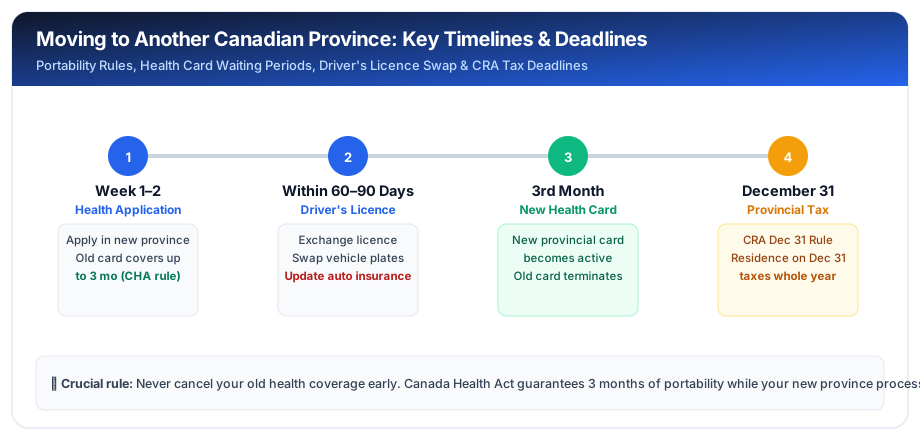
When you move provinces, you transition between independent provincial systems. Complete these four critical priorities first:
1. Health card
Apply in the new province right away. Your old province covers you for up to 3 months under the Canada Health Act. Compare coverage by province.
2. Driving
Exchange your licence and register your vehicle within provincial deadlines (e.g. 60 days in Ontario, 90 days in Alberta).
3. Taxes
The province where you reside on December 31 taxes your entire year's income. Update CRA and submit a new TD1 form to your employer.
4. Address
Update CRA My Account, Canada Post mail forwarding, bank, insurer, and professional regulatory boards.
Can you move to another province in Canada? Legal rights & restrictions
Under Section 6 of the Canadian Charter of Rights and Freedoms, every Canadian citizen and permanent resident has the constitutional right to move to and take up residence in any province, and to pursue the gaining of a livelihood in any province. However, your legal standing and practical requirements depend on your immigration category:
Citizens & Federal PRs
100% Unrestricted. Express Entry (CEC, FSW) permanent residents and citizens can relocate across any provincial border at any time with zero immigration restrictions or penalty.
Provincial Nominees (PNP)
Conditional Intent. Charter Section 6 protects PRs, but IRCC can investigate misrepresentation if you applied under a PNP with no genuine intention to reside in that province.
Open Work Permits (PGWP/SOWP)
Full Mobility. Holders of Post-Graduation Work Permits or Spousal Open Work Permits can live and work in any Canadian province without amending their visa status.
Closed Work Permits
Restricted. Employer-specific work permits legally tie you to a named employer and location. You cannot start work in another province without a new LMIA or permit variation.
How to change your province of residence: step by step
There is no single form that changes your province of residence. You become a resident of the new province by living there and registering with its health plan and licensing office, and the CRA treats you as a resident of the province you live in on December 31. Do these in order:
- Get proof of address in the new province: a lease, deed, or utility bill in your name. Every later step asks for it.
- Apply for the new health card in your first week. Keep your old card until the new coverage starts (see health coverage).
- Exchange your driver's licence before the deadline in the table below. Moves between provinces normally need no road test.
- Register and insure your vehicle in the new province.
- Update your address with the CRA (My Account or Form RC325) and give your employer the new province's TD1 form.
- Update Elections Canada and the provincial elections office, your bank, insurer and any professional regulator.
| Moving to | Health card portal & interprovincial wait | Driver's licence exchange & deadline | Vehicle registration & auto insurer | Address change & childcare portal |
|---|---|---|---|---|
| Ontario | OHIP (ServiceOntario) — no waiting period | 60 days · Ontario.ca | 6 days after becoming resident · ServiceOntario (private auto insurance) | Ontario Address Change · Child Care |
| British Columbia | MSP (Health Insurance BC) — arrival month + 2 months | 90 days · ICBC | 30 days · ICBC Autoplan (public basic insurer) | AddressChange BC |
| Alberta | AHCIP — 1st day of 3rd month | 90 days · Alberta.ca | 90 days · Alberta Registry Agent (private auto insurance) | Alberta Child Care |
| Quebec | RAMQ — up to 3 months | 6 months · SAAQ | 90 days after you settle in Quebec · SAAQ (public bodily injury + private property insurance) | SQCA Address Change · La Place 0-5 |
| Manitoba | Manitoba Health — 1st day of 3rd month | 3 months · MPI | 3 months · MPI Autopac (public auto insurer) | MB Health Coverage |
| Saskatchewan | eHealth Saskatchewan — 1st day of 3rd month | 90 days · SGI | 90 days · SGI Auto Fund (public auto insurer) | eHealth Portal |
| Nova Scotia | MSI (Nova Scotia) — 1st day of 3rd month | 90 days (180 days visitors) · Nova Scotia | 30 days · Access Nova Scotia RMV (private insurer) | NS Health Program |
| New Brunswick | NB Medicare — 1st day of 3rd month | As soon as resident · GNB | Immediately upon residency · Service New Brunswick (private insurer) | NB Drug & Health |
| Prince Edward Island | PEI Medicare — 1st day of 3rd month | 4 months · PEI | 30 days (registration) · Access PEI (private insurer) | Health PEI Portal |
| Newfoundland and Labrador | MCP — 1st day of 3rd month | 3 months · Gov NL | 30 days (vehicle registration) · Motor Registration Division (private insurer) | NL Health Services |
Official provincial portals and statutory deadlines verified November 2026. Exchanges from another Canadian province (or a U.S. state under reciprocity) normally require no road test, but you must surrender your previous licence and provide proof of residency.
Health coverage: the 3-month portability rule
The Canada Health Act requires your old province to keep covering you for up to 3 months after you move, so you are not uninsured while the new province processes your application. What changes is when the new province takes over:
| Moving to | When new coverage starts | Source |
|---|---|---|
| Ontario (OHIP) | No waiting period once eligible; you must be in Ontario 153 days in any 12 months | Ontario.ca |
| British Columbia (MSP) | Rest of the arrival month plus two months | BC Gov |
| Alberta (AHCIP) | First day of the third month after you establish residency; apply within 3 months | Alberta.ca |
| Quebec (RAMQ) | Register with RAMQ after you settle; see the Ontario to Quebec checklist | RAMQ |
Moving to Quebec: a doctor in another province may bill you even if you show your old card, so pay, keep the itemized receipt and claim it back from the old plan (for Ontario, OHIP accepts claims filed within 12 months, at Ontario rates).
Specialist referrals and family-doctor waitlists do not transfer: While your former province covers insured doctor and hospital visits during the waiting period, non-emergency specialist referrals, surgery or MRI queues, and provincial family-doctor registries (such as Ontario's Health Care Connect, B.C.'s Health Connect Registry, and Quebec's Guichet d'accès à un médecin de famille) stop at the provincial border. Request copies of your medical records, imaging, and prescription history before leaving, and get a new local referral once you arrive.
How to become an Ontario resident from another province
Ontario is the most common destination for interprovincial moves, and its rules are specific:
How to become a B.C. resident from another province
Becoming a British Columbia resident is split across Health Insurance BC (MSP), ICBC, and the CRA, each with its own clock:
Comparing neighbourhoods before you move? See 24 B.C. and Metro Vancouver cities compared for household income, immigrant communities, renters and 2025 crime severity.
Moving from Quebec to another province (changement de province)
Moving out of Quebec involves leaving three Quebec-only institutions — RAMQ, Revenu Québec, and the SAAQ — and joining the federal/provincial system used in the rest of Canada (for an Ontario-bound move, see our full Moving from Quebec to Ontario Checklist):
- Right to move: Canadian citizens and permanent residents can move freely from Quebec to any other province under Section 6 of the Charter. (If you recently immigrated through a Quebec selection program or hold a closed work permit tied to a Quebec employer, verify your permit or landing conditions first.)
- Health card (RAMQ to OHIP / MSP / AHCIP): Notify RAMQ that you are settling in another province. Under the interprovincial portability agreement, your RAMQ card remains valid for up to 3 months while you complete any waiting period in your new province (Ontario's OHIP has no waiting period once you apply at ServiceOntario).
- Taxes (leaving Revenu Québec): Because provincial income tax is based on where you live on December 31, moving out of Quebec before December 31 means you only file a single federal/provincial return with the CRA for the entire year — no separate Revenu Québec return is required for that tax year. Notify Revenu Québec of your new address so solidarity tax credit or family allowance payments are adjusted.
- Pensions (QPP to CPP): Your Québec Pension Plan (RRQ/QPP) contributions do not need to be transferred manually; QPP and the Canada Pension Plan (CPP) share records and combine your contribution history automatically when you retire.
- Driving (SAAQ): Exchange your Quebec driver's licence and plate in your new province first, then notify the SAAQ to cancel your Quebec registration and claim any pro-rated refund.
Taxes: the CRA December 31 rule & tax arbitrage
For Canadian personal income tax, the Canada Revenue Agency (CRA) does not pro-rate your income across provinces if you move during the calendar year. Instead, your province of residence on December 31 determines your provincial tax rate for your entire year's worldwide income.
Self-employed? That rule is for employment income. On the CRA's province or territory of residence instructions, a business is listed by each province where it had a permanent establishment, so that income is not automatically all taxed in your December 31 province. Ask a tax professional if you moved and kept a business in the old province.
This single rule creates significant tax differences depending on whether you move in late December or early January:
| Relocation Scenario | December 31 Residency | Estimated 2026 Income Tax, Federal + Provincial ($100k Salary) | Net Tax Impact |
|---|---|---|---|
| Ontario → Alberta | Alberta (moved Dec 28) | ~$19,770 (AB) | Save ~$250 vs Ontario (~$20,020 incl. $750 Ontario Health Premium) + no provincial sales tax on future purchases |
| Alberta → Ontario | Ontario (moved Dec 28) | ~$20,020 (ON) | Pay ~$250 more than if the move was delayed to Jan 2 |
| Quebec → Ontario | Ontario (moved Dec 28) | ~$20,020 (ON) | Save ~$3,700 vs Quebec (~$23,720 after the 16.5% federal abatement), plus ~$590 less in QPP/QPIP payroll contributions and a single CRA return |
| Ontario → British Columbia | BC (moved Dec 28) | ~$18,870 (BC) | Save ~$1,150 vs Ontario (BC's lowest brackets are 5.6% and 7.7%) |
All 10 provinces: income tax if you live there on December 31
For monthly take-home pay at other salaries, see take-home pay by province.
| Province on December 31 | 2026 income tax, federal + provincial ($100k salary) | vs Ontario |
|---|---|---|
| British Columbia | ~$18,870 | ~$1,150 less |
| Alberta | ~$19,770 | ~$250 less |
| Ontario | ~$20,020 | — |
| Saskatchewan | ~$21,940 | ~$1,920 more |
| Manitoba | ~$22,790 | ~$2,760 more |
| New Brunswick | ~$23,020 | ~$2,990 more |
| Quebec | ~$23,720 | ~$3,700 more |
| Newfoundland and Labrador | ~$23,790 | ~$3,770 more |
| Prince Edward Island | ~$24,440 | ~$4,420 more |
| Nova Scotia | ~$25,360 | ~$5,340 more |
Simplified 2026 estimates from this site's tax calculator: single filer, $100,000 employment income, basic personal amounts and CPP/EI credits only. Not tax advice. Brackets: CRA income tax rates.
Deducting your moving costs: CRA Form T1-M
If you move to another province for work, to start a business, or to study full-time at a post-secondary institution, you can deduct eligible moving expenses on your tax return under CRA Form T1-M, provided your new home is at least 40 kilometers closer to your new workplace or university.
- Eligible deductions: Professional movers or truck rental, travel costs (gas, meals, vehicle mileage), temporary living expenses (up to 15 days lodging and meals near either old or new home), cost of cancelling an unexpired lease, and legal or real estate fees when selling your former residence.
- Deduction limit: You can only deduct moving expenses against employment or self-employment income earned at your new location. Any unused moving expenses can be carried forward to future tax years indefinitely.
- Proposed flat amount (2027+): the Budget 2026 tax measures (November 5, 2026) propose letting you deduct a flat $1,000 per eligible move instead of tracking receipts, starting with the 2027 tax year. A long-distance move usually costs more than that, so keep receipts anyway.
- Update payroll immediately: Fill out a new provincial TD1 form with your employer as soon as you relocate so provincial source deductions match your upcoming tax liability.
To calculate your precise after-tax difference and living costs, use the ProvinceCompare calculator.
Driver's licence, vehicle and insurance
Every province sets its own deadline for exchanging an out-of-province licence, from “as soon as you take up residence” in New Brunswick to 180 days in Nova Scotia (see all 10 provinces). Quebec also wants your new address within 30 days. Exchanges between Canadian provinces normally do not require a road test, but bring your old licence and proof of residency.
Is the licence deadline 90 days in every province?
No. The deadline table above is the rule, and the numbers are not the same: Ontario is 60 days, British Columbia and Alberta are 90 days, and Quebec allows six months for the licence, though the car must be registered with the SAAQ within 90 days of settling there. ICBC splits its own clocks: 90 days to exchange the licence and 30 days to register and insure the car, and an old B.C. licence stays valid for 90 days after you leave. The part people skip is the policy address. ICBC says that if Autoplan does not show where you live and how the car is used, you might not be covered when you claim. Exchanging the card late because nobody asked to see it does not change that. Insure the car in the province where it is kept, before the deadline in the table.
Register and insure your vehicle in the new province. Four provinces sell basic auto insurance through a public insurer: B.C. (ICBC), Saskatchewan (SGI), Manitoba (MPI) and Quebec (SAAQ). Elsewhere you buy it from private insurers, and your premium can change sharply with the move (for example, moving between Quebec or B.C. and private-market Ontario or Alberta). Download your claims-experience letter and driver's abstract before you surrender your old licence.
Does my car insurance follow me, or do I need a driving record?
The old policy does not cover the car once it is kept in the new province. In British Columbia, ICBC gives you 30 days to insure it and does not ask for the old policy. It asks for proof of how long you have held a full licence (a driver's abstract or a letter of experience), credits up to 15 years of it toward Basic insurance, and still adjusts the premium for your first three years. Order the record before you surrender the old licence. Ontario uses its driver record for insurance and for a licence elsewhere; an uncertified copy is $12. Alberta's standard abstract does not show the date you were first licensed, so ask the new insurer which letter they need. Missing paperwork means they cannot see those years. It does not mean you are licensed as a beginner.
Out-of-province vehicle inspections (OPI): Most provinces require a mechanical inspection before plating a car from another province. Ontario requires a Safety Standards Certificate (valid for 36 days). Alberta requires an Out-of-Province Vehicle Inspection measured against OEM service limits: if your vehicle fails, repairs must be completed within 10 days, and once it passes you must present the certificate to an Alberta registry agent within 14 days or repeat the full inspection (New West Partnership inspection exemptions only apply to eligible newer vehicles moving between B.C., Alberta, Saskatchewan, and Manitoba — not from Ontario or Quebec).
Work, licences and immigration status
- Banks and credit unions: Canada's major banks (RBC, TD, Scotiabank, BMO, CIBC, Tangerine, Simplii) are federally regulated and work across all provinces — you keep your existing account, transit number, and direct deposit, and simply update your residential address so tax slips (such as T5s vs Quebec RL-3s) match your December 31 province. Provincially regulated credit unions (such as Vancity in B.C., Servus in Alberta, or Meridian in Ontario) may restrict out-of-province lending or branch services.
- Regulated professions: nurses, teachers, engineers and trades are licensed by province. Under the Canadian Free Trade Agreement, a licence from one province is generally recognized in another, but you still have to register with the new regulator before you work.
- Permanent residents: mobility rights let PRs live anywhere in Canada. If you came through a Provincial Nominee Program, speak to a licensed consultant before moving soon after landing.
- Work permits: an employer-specific permit ties you to that employer and location, not just a province. Check the conditions on your permit before you relocate.
- Children: register with the new school board early; some boards fill French immersion and popular schools months ahead.
Does our cheap daycare spot move to the new province?
No. The lower fee is what you pay at a provider licensed where you live now. It is not a benefit that follows the child. Quebec's own page sets the 2026 reduced contribution at $9.65 a day in a subsidized place. Ontario's reduction is different: it applies only if the licensed program you attend is in the Canada-wide system, parents do not apply for the discount, and the capped fee is $22 a day as of January 2025, about $19 on average. Canada signs a separate agreement with each province, and no federal page describes moving a space or a waitlist position. When you move, ask licensed programs in the new province for a place. A centre that is not in Ontario's system charges its own fee.
Moving to another province: printable checklist
Frequently asked questions
Still choosing which province?
Compare take-home pay, rent and groceries across provinces before you sign a lease: take-home pay by province, average rent by city and grocery prices by province.